The audio annotation tool you choose for your ML projects has a large impact on your audio AI models. There is no single best tool; the ideal tool depends on your use cases, budget, and data formats. A good platform improves the effectiveness and quality of your audio datasets, while the wrong one impedes everything.
Earlier, we published a comprehensive review of the top seven proprietary audio annotation tools. Now, we are going to review the 6 best open-source audio labeling tools, based on usage, features, and GitHub stars (as a proxy for community strength).
 Hojiakbar Barotov
7 Proprietary Audio Annotation Tools
We will dive into each platform: pros and cons, performance, use cases, usability, and more.
Here are the 6 audio labeling tools that are free and open-source:
- Audino
- Whombat
- ELAN
- Anvil
- Diffgram
- LabelStudio
But first, let's see why you might want to choose open-source audio platforms.
Why Open-Source Tools?
Open-source audio annotation tools are improving fast. You get transparency, control of your data, and room to customize. You avoid vendor lock-in, and you can host everything on your own servers.
In addition to the benefits above, you face no direct monetary costs. You do not pay for subscriptions or licenses.
You likely choose open-source audio annotation tools when:
- You want full control over datasets.
- You plan to integrate custom workflows or models.
- You need reproducibility for research.
- Your team prefers self-hosted systems.
- You have strict privacy requirements.
Paid audio labeling tools offer more automation, features, support, and long-term stability, but open-source tools give you freedom and customization.
However, the choice between proprietary and open-source always depends on your exact needs. We are reviewing these tools from a neutral position.
Open-Source Audio Labeling Tools
Below is a quick view of features and focus areas:
| Tool | Best For | Key Features | License |
|---|---|---|---|
| Audino | Speech tasks | Segment-level labels, simple UI | MIT |
| Whombat | Research Workflows | Multi-annotator pipeline, Python API | GPL-3.0 |
| ELAN | Linguistics | Tiers, multi-speaker annotation, time-aligned labels | GPL |
| Anvil | Behavioral analysis | Multi-track annotation, video+audio | Freeware |
| Diffgram | General ML workflows | Audio+vision+NLP, automation | Apache 2.0 |
| LabelStudio | Multi-modal workflows | Audio regions, time-series labeling, plug-ins | Apache 2.0 |
1. Audino
Audino is one of the most active open-source audio labeling platforms. Designed for simplicity, it offers manual annotation of audio datasets at the segment level for precision.
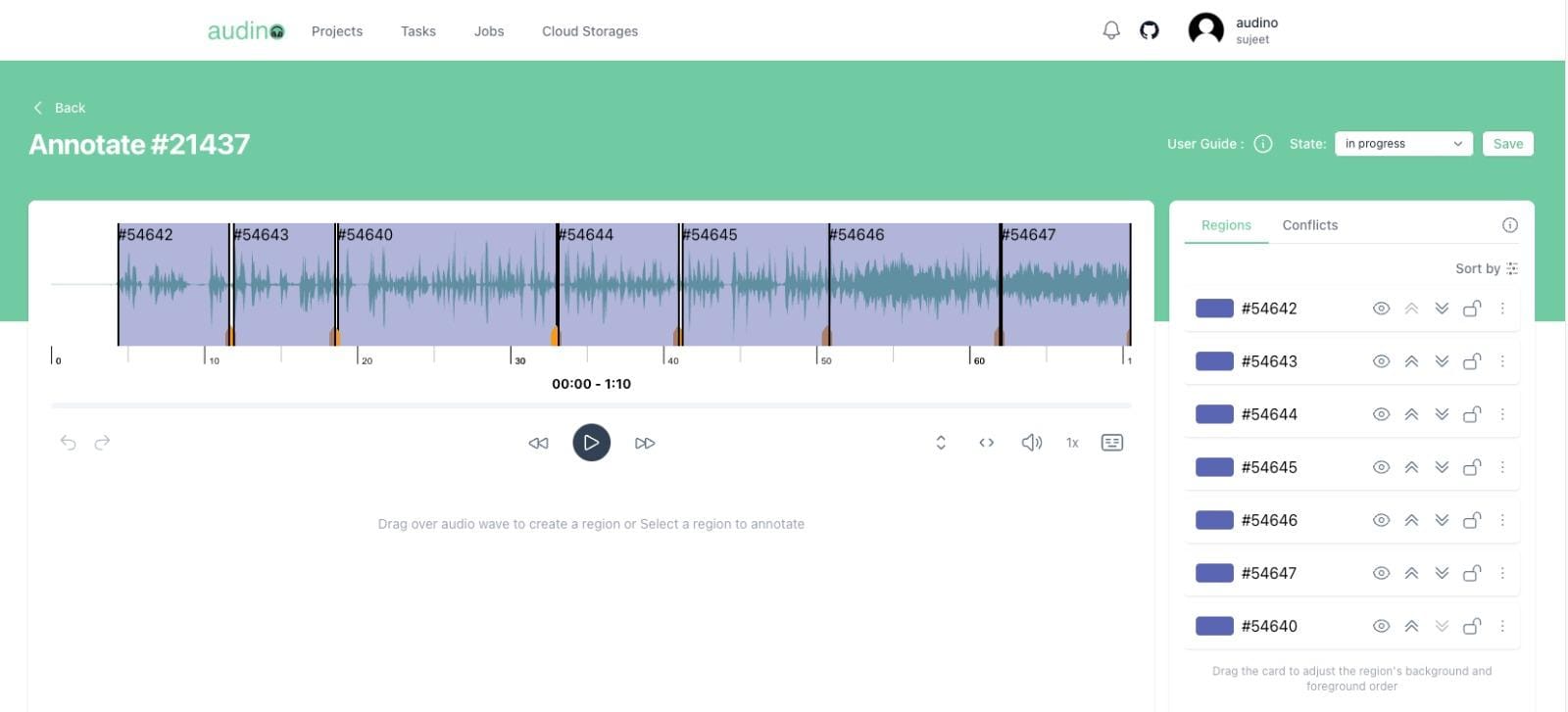
It provides labeling for speech segmentation and transcription tasks in multiple languages.
You get:
- Clean browser-based UI.
- Support for speech labeling, classification, timestamps, and segments.
- Detailed precision and control over audio annotation.
Audino is ideal for research-focused projects and teams at a smaller scale that do not mind manual audio labeling.
2. Whombat
Whombat is an almost open-source alternative to audio annotation tools because it stands as a complete audio labeling platform.
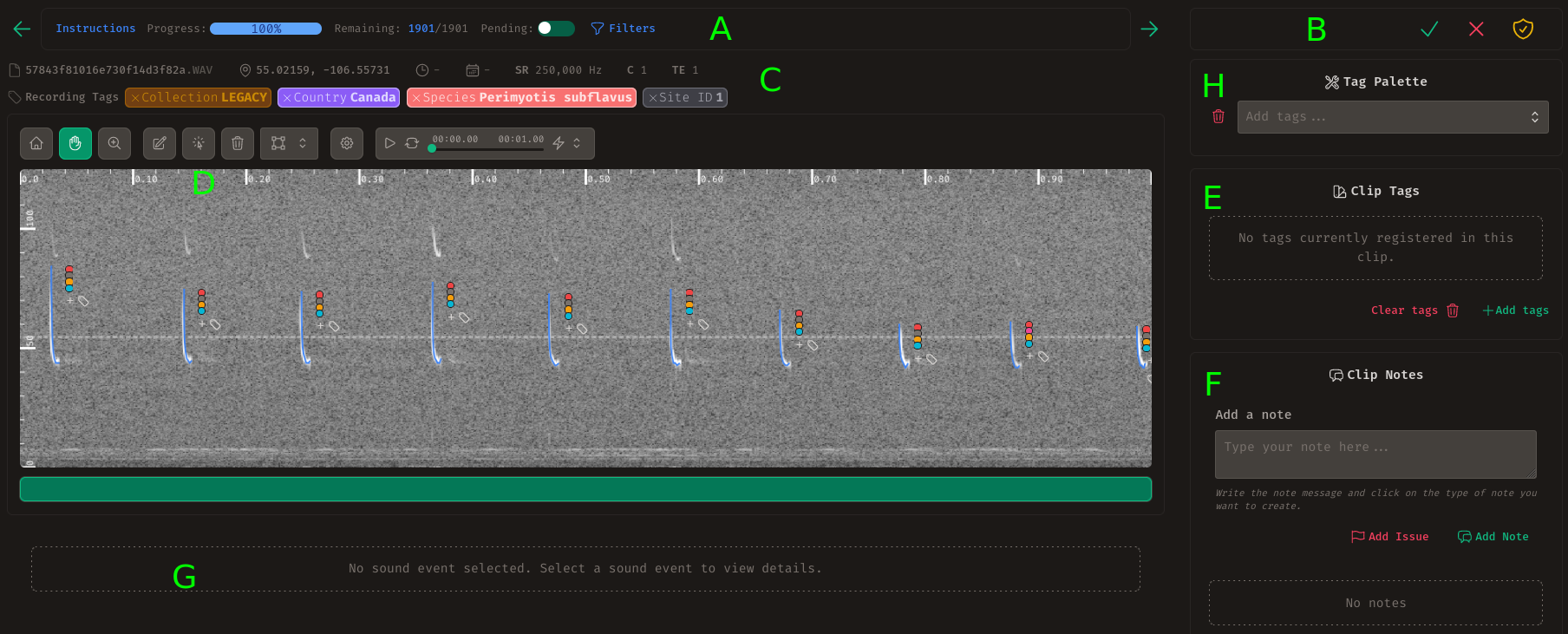
Whombat is still in active development, so it may not be time-tested yet. However, this audio tool holds great potential.
Features:
- Evolving datasets and dataset version control.
- Import/Export annotations in several formats, including ML-friendly formats.
- Flexible/precise audio labeling with annotation review.
- Useful for research datasets in ASR and audio classification.
- Python and REST API for developers.
Whombat appears frequently in research settings because it gives you tight control over annotation logic.
3. ELAN (EDICO LINGUISTIC ANNOTATOR)
ELAN, a free tool developed by the Max Planck Institute for Psycholinguistics, is the de facto standard in linguistics, phonetics research, and multimodal annotation.
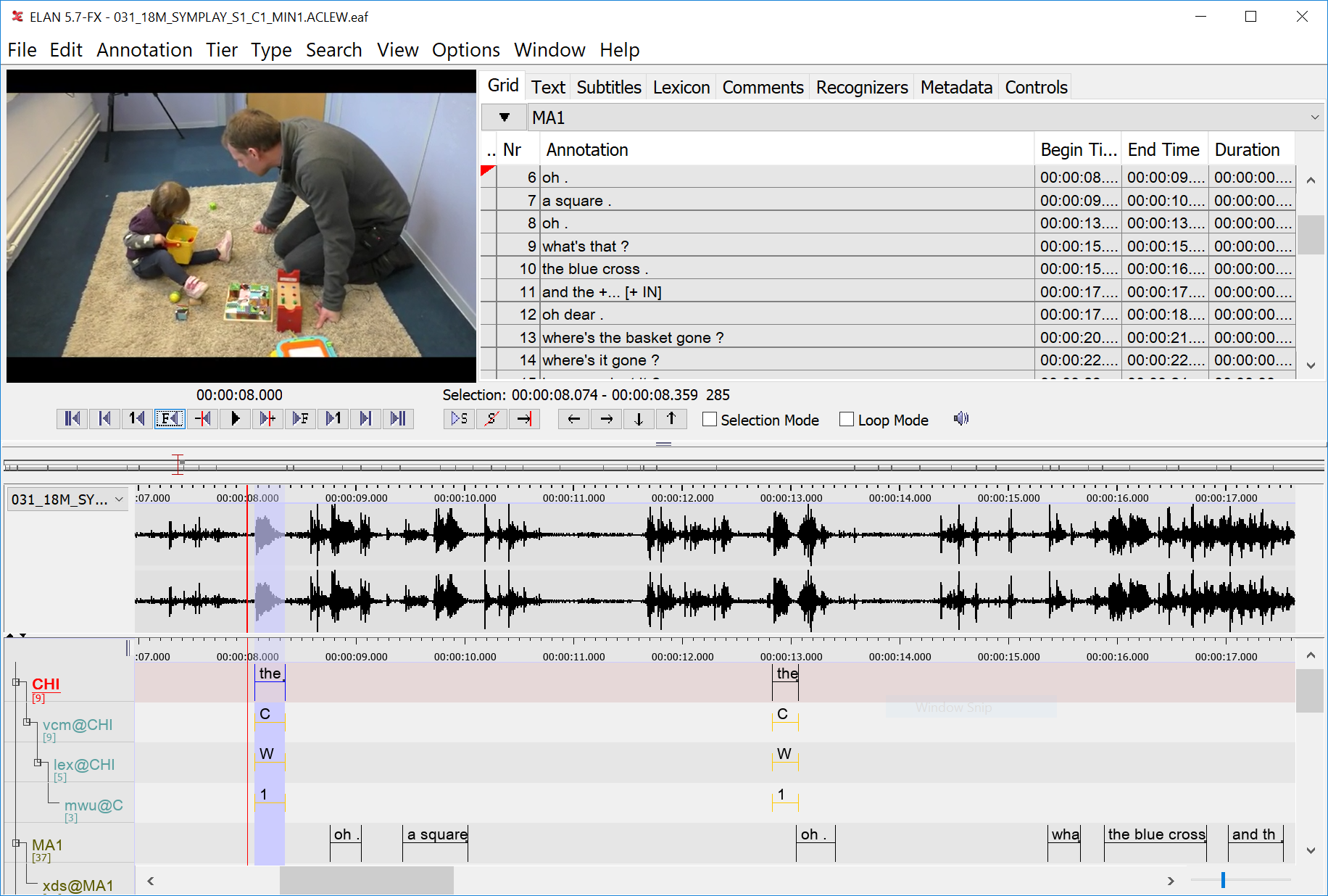
If you need multi-tier annotations or work with multiple speakers, ELAN provides unmatched structure, especially in research settings where high customization is essential.
Features:
- Time-aligned annotations with unlimited tiers.
- Designed for linguistics, anthropology, phonetics, sign language research.
- Handles both audio and video.
- Precise timestamp control down to the millisecond.
ELAN remains the most academically trusted tool for audio transcription and linguistics.
4. Anvil
Anvil is a long-standing free tool for multimedia annotation. It supports audio and video together, so it fits behavioral research, UX studies, and multimodal analysis.
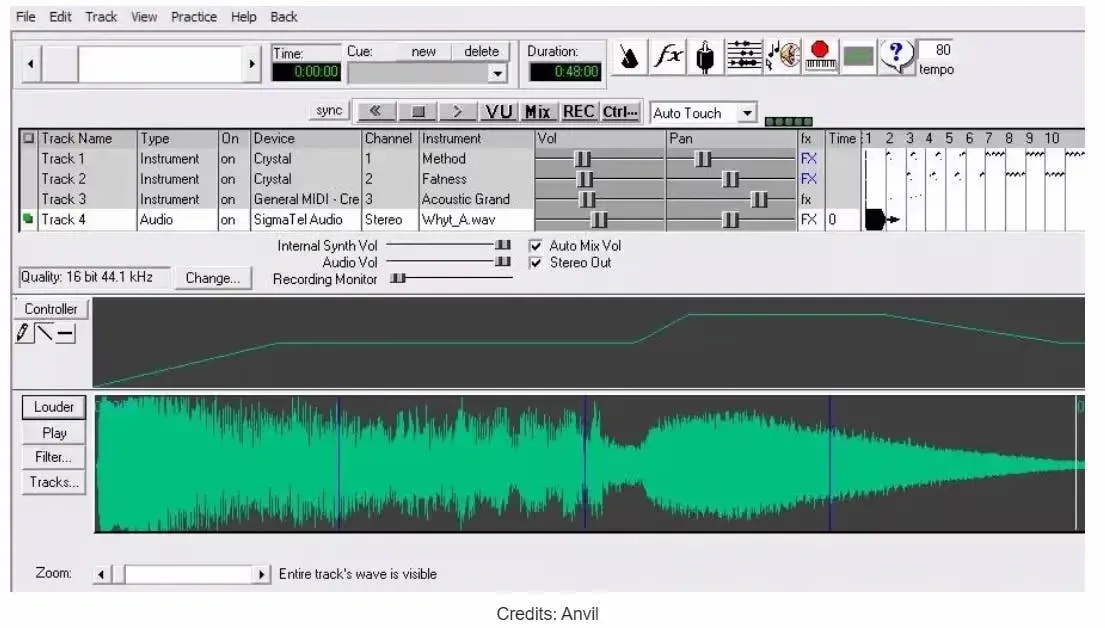
Features:
- Multi-track timelines for audio and video.
- Configurable annotation schemes.
- Suitable for prosody, gesture studies, speech analysis.
- XML-based project files for versioning.
Anvil works well when your annotation goes beyond audio alone.
5. Diffgram
Diffgram is an open-source alternative to end-to-end commercial annotation suites for large-scale ML models. It can annotate audio, video, and image files.
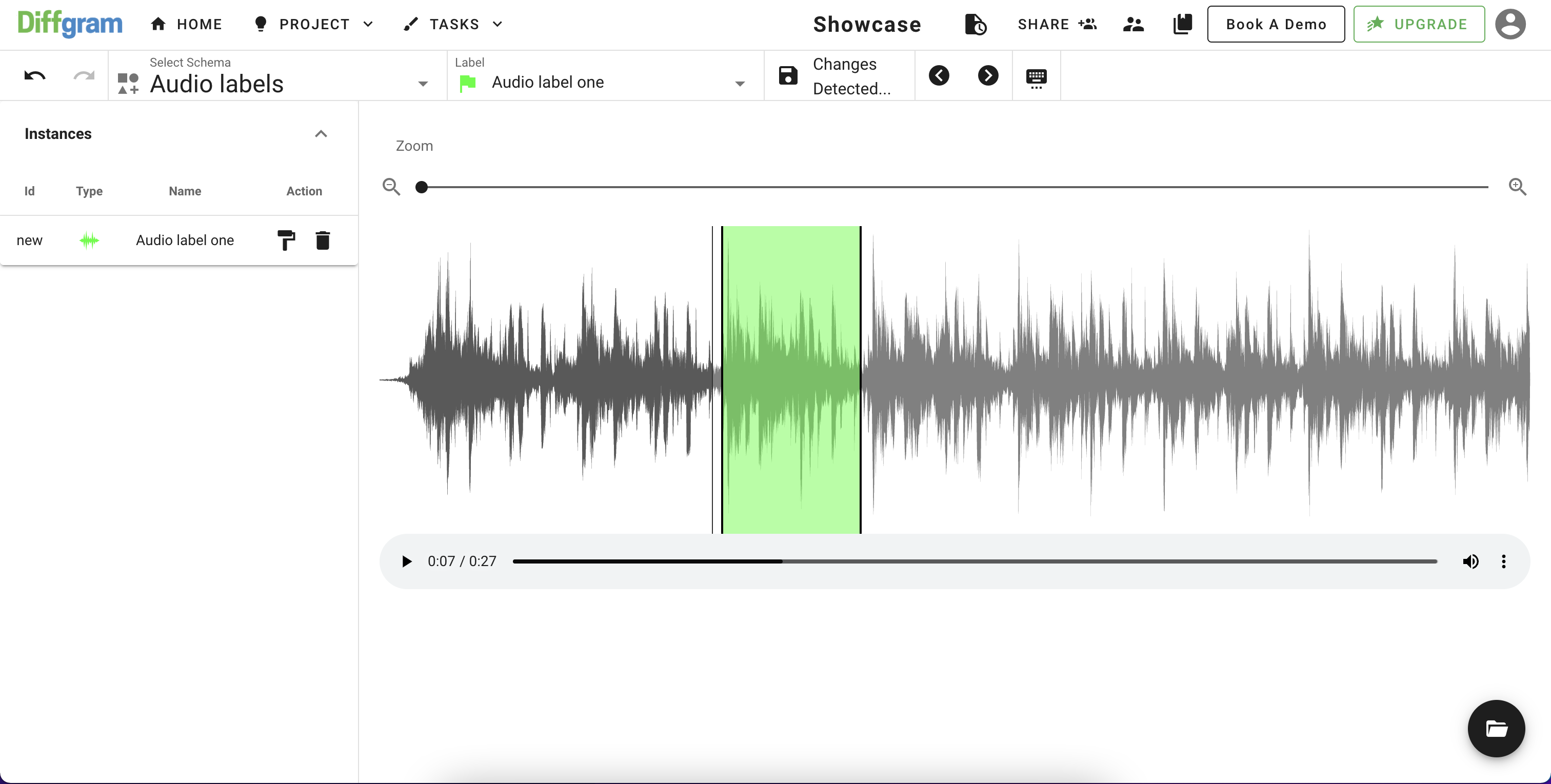
Its strong focus on integrations with ML pipelines makes it easy to incorporate and scale.
Features:
- Workflow automation.
- Audio segmentation and labeling interface.
- User management and real-time collaboration.
- Integrated, built-in dataset control and versioning.
- Model-assisted labeling.
Diffgram is strong when your annotation includes multiple data types for large-scale ML projects.
6. LabelStudio
LabelStudio is arguably the most flexible open-source annotation tool. It is open-source but also provides paid enterprise support.
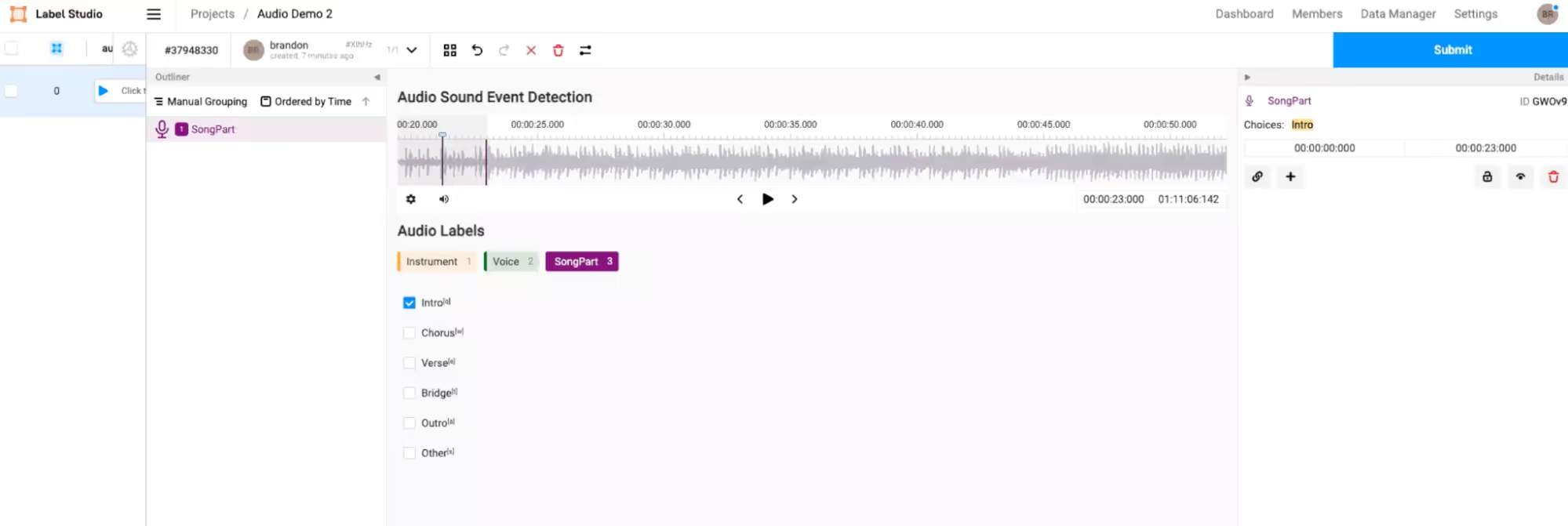
It supports almost every data type, from images to audio to text to time-series, and has an active ecosystem of plugins. It is an end-to-end data annotation platform built on open-source technologies.
For audio, you get:
- Region selection on waveforms.
- Classification labels.
- Sequence labeling and time-series features
- Plug-ins for ASR preprocessing.
ML teams choose LabelStudio when they want full extensibility and multi-modal workflows.
Why Not Open-Source?
Open-source audio annotation tools are powerful but do not suit every use case. They come with inherent trade-offs.
First, open-source is not free in an economic sense. You do not pay monetary value, but you pay with developer time.
Also, there is no guarantee that your chosen audio labeling platform will continue to be developed. The image processing library in Python (PIL) had to be forked into Pillow because of inactivity and lack of maintenance. In extreme cases, an open-source project can simply drop dead, as happened with LeftPad in 2016.
Finally, you face:
- No built-in enterprise-level automation.
- Limited support for huge datasets.
- Fragmented UI or slow updates.
- No managed cloud hosting unless you deploy it yourself.
- Less mature collaboration features.
If you want speed, automation, and ready-to-use AI models, proprietary audio annotation tools are easier to adopt.
If you plan to focus on core audio annotation with auto-annotation tools, strong collaboration, dataset control, and project management features, choose Unitlab AI, a fully automated data platform. Try our audio annotation tool in under 5 minutes for free:
Conclusion
Open-source audio annotation is strong in 2025.
Audino, Whombat, ELAN, Anvil, Diffgram, and Label Studio cover most use cases with inherent trade-offs. Your choice depends on your annotation goals for your ML datasets.
- Speech projects tend to pick Audino or Whombat.
- Linguistics teams use ELAN.
- Multimodal researchers choose Anvil or Diffgram.
- General ML teams often adopt Label Studio.
Use open-source when you want control and customization. Use proprietary tools such as Unitlab AI when you want speed, automation, stability, and efficiency.
Explore More
Check out these articles for more on audio annotation and open-source data labeling tools:
- Audio Data Annotation with Unitlab AI [2025]
- 7 Best Proprietary Audio Annotation Tools of 2025 - A Comprehensive Review
- Top 5 Open-Source Computer Vision Models
References
- Justin Sharps (Oct 29, 2024). Top 9 Audio Annotation Tools. Encord Blog: Source
- iMerit (no date). Top 10 Tools for Audio Annotation in 2025: A Comprehensive Guide. iMerit: Source
- Sumit Singh (Jan 09, 2024). 10 Best Audio Annotation & Labeling Service Providers In 2025. Labellerr: Source
- Vicky (May 08, 2025). Best Audio Annotation and Labelling Services for AI Models. Twine: Source